




Introduction to Fluorescence Filters: Principles, Selection, and Applications



Table of Contents
Optical filters are crucial for transmitting, suppressing, and directing desired wavelength ranges in fluorescence techniques, ensuring efficient excitation of fluorophores and accurate collection of emitted light. These filters are essential for ensuring high signal throughput, reducing background noise, and enabling precise detection in both imaging and analytical systems. This application note discusses different types of fluorescence filters, such as excitation, dichroic, and emission filters, as well as their roles in various fluorescence detection and imaging techniques. It also explains how to choose suitable filters for different fluorophores and provides useful tools to assist with the process.
Types of Filters Used in Fluorescence Applications
Fluorescence filter sets generally consist of three primary components (Figure 1):
Excitation Filter (Exciter): The excitation filter transmits only the wavelengths required to excite the selected fluorophore, blocking all other wavelengths from the light source.
Dichroic Filter (also Dichroic Beamsplitter or Dichroic Mirror): Dichroic filters, typically used at a 45° angle, are critical in both the excitation path (before sample) and emission path (after sample). In light sources, dichroics are often used for beam combining. Within the emission path, dichroic filters reflect excitation light toward the sample and transmit longer-wavelength emission light to the detector. Certain dichroics may require very steep edges to mitigate light leakage while maximizing signal.
Emission Filter (Emitter): The emission filter blocks any remaining excitation light while allowing the fluorophore's emitted fluorescence to reach the detector. High blocking efficiency and steep spectral edges are required for clear signal collection.
While this section focuses on the traditional epifluorescence configuration that includes an excitation filter, dichroic mirror, and emission filter, there are other options available. These include shortpass-based systems in which the roles of excitation and emission filters are reversed (for example, shortpass filters used to reflect shorter-wavelength emission while transmitting longer-wavelength excitation), as seen in multiphoton microscopy, where the excitation wavelength is longer than the emitted fluorescence. There are also linear or non-epifluorescence setups in which the excitation and emission paths are geometrically separated, eliminating the need for a dichroic mirror altogether.

Selecting the Right Filter Combination for Your Fluorophore
Effective fluorescence imaging is dependent on the filter set's spectral compatibility with the fluorophore's excitation and emission profiles. Each filter must closely align with the fluorophore's spectral peaks while avoiding overlap with adjacent filter passbands in multiplexed (multicolor) experiments in which more than one fluorophore’s signal is being detected. With hundreds of commercially available fluorophores on the market today, many of which have overlapping spectra, careful filter selection is critical. In some cases, custom coating designs may be required to tailor passbands for peak performance.
Examples of Fluorophores and Recommended Filter Sets:
| Fluorophore | Excitation (nm) | Emission (nm) | Recommended Filters |
|---|---|---|---|
| FITC | ~495nm | ~519nm | EX: 470/40nm, Dichroic: 495nm, EM: 525/50nm |
| Cy5 | ~649nm | ~666nm | EX: 640/30nm, Dichroic: 660nm, EM: 685/40nm |
| DAPI | ~358nm | ~461nm | EX: 350/50nm, Dichroic: 400nm, EM: 460/50nm |
| ROX | ~575nm | ~610nm | EX: 575/25nm, Dichroic: 600nm, EM: 610/40nm |
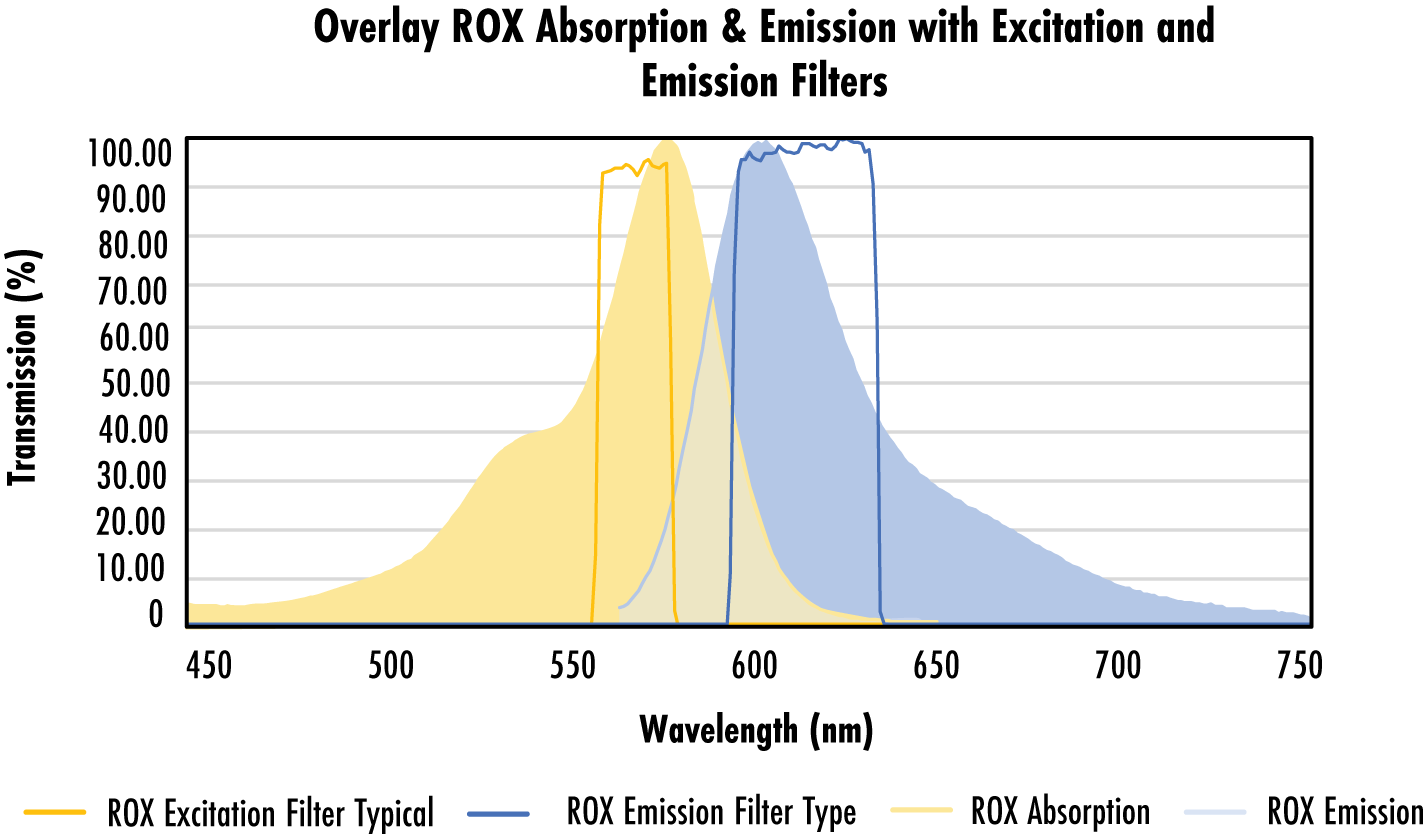
Single Band vs. Multiband Filters
Single band filters target a specific wavelength range, making them suitable for detecting a single fluorophore emission band with high specificity and minimal crosstalk. Multiband filters allow the simultaneous excitation or emission of multiple fluorophores, which is helpful in multiplex assays and multicolor fluorescence microscopy. Although multiband filters increase throughput and reduce the overall number of components in a system, they require careful spectral design to prevent overlaps.
Multiband Filter Configurations: Pinkel and Sedat Setups
Filter configurations for multicolor fluorescence imaging must balance speed, spectral separation, and signal fidelity. Two popular configurations, Pinkel and Sedat, provide optimized solutions for various imaging priorities.
- Pinkel Configuration: Uses single-band excitation filters (typically in a filter wheel or multi-LED system) in conjunction with a multiband dichroic and emission filter. This configuration allows for rapid switching between fluorophores with few moving parts and is ideal for high-speed imaging applications. However, because all emission wavelengths are collected using the same multiband emission filter, spectral bleed-through may occur.

- Sedat Configuration: Uses single-band excitation and emission filters, as well as a shared multiband dichroic. While this setup requires more filter changes (typically via motorized wheels), it provides superior spectral isolation and reduces crosstalk, making it ideal for high-fidelity, multi-channel fluorescence imaging.

Filter Cubes
Filter cubes combine the excitation, dichroic, and emission filters into a compact, pre-aligned module. They are widely utilized in fluorescence microscopes and imaging systems. Edmund Optics® provides standard and custom filter cubes that are designed to fit a wide range of commercial platforms, simplifying integration and ensuring peak performance. Filter cubes may be populated with either single-band or multiband filters, depending on the application and number of colors. For systems requiring rapid switching between filters or configurations, Edmund Optics® also offers motorized and manual filter wheels, as well as microscope turrets adaptable for use with filter cubes.

The emission filter is typically mounted at 5° in fluorescence filter cubes and should therefore be designed with a 5° AOI tolerance in mind to maintain optimal system performance and avoid a blue shift of the central wavelength transmission.
Application Examples
Fluorescence filters are critical in a variety of life science and molecular diagnostic applications, each with unique filter requirements.
- Fluorescence Microscopy: Imaging of cellular and subcellular structures using labeled antibodies, dyes, or fluorescent proteins.
- qPCR: monitoring of DNA amplification using fluorescent probes.
- Flow Cytometry: Sorting and analysis of cell populations based on surface marker expression.
- Fluorescence Spectroscopy: A quantitative measurement of emission intensity used in biochemical assays.
- Genome Sequencing: detection of nucleotide incorporation events using color-coded fluorophores.
Fluorescence Filters at Edmund Optics®
Edmund Optics® designs and manufactures hard coated optical filters from prototype quantities through high volume production.
Learn More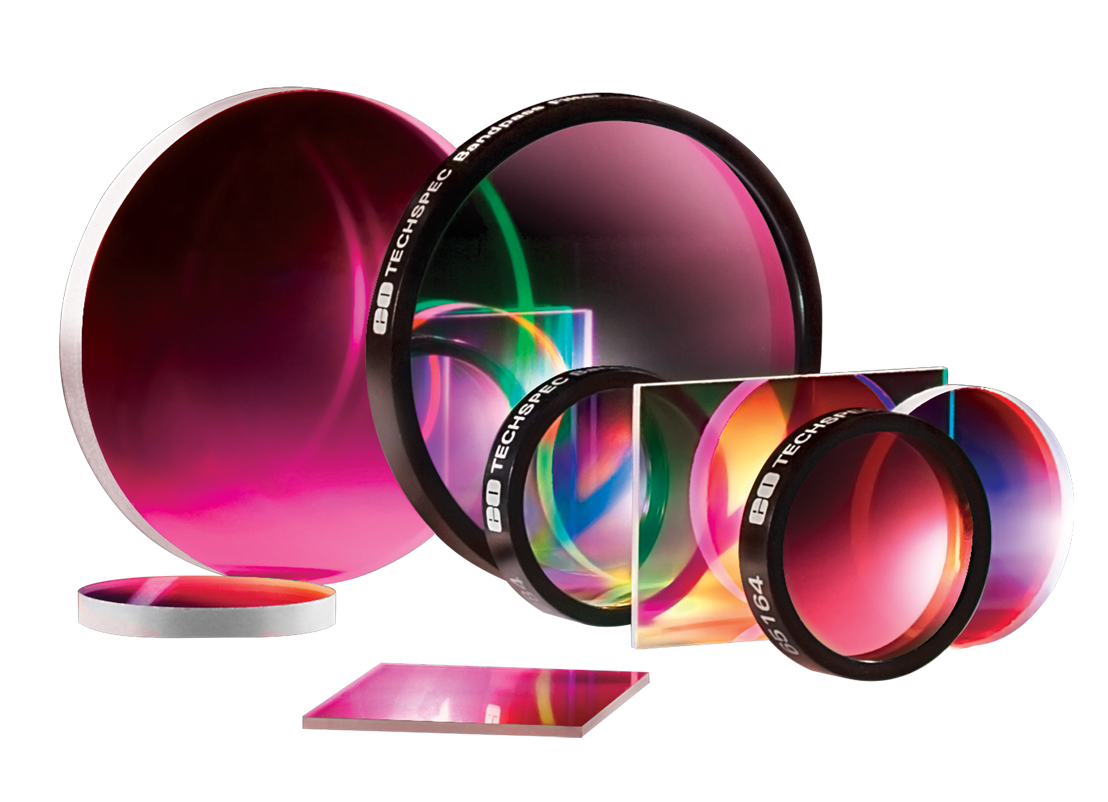
Please Contact Us for more information and guidance from our engineers on selecting the right filters and other optics for your system.
References
- Erdogan, T. (2006). New Optical Filters Improve High-Speed Multicolor Fluorescence Imaging. BioPhotonics.
- Scientifica. (2019, October 31). Widefield fluorescence microscopy: What you need to know. Judges Scientific PLC.
weitere regionale Telefonnummern
ANGEBOTSTOOL
Geben Sie zum Starten die Produktnummer ein.
Copyright 2023 | Edmund Optics, Ltd Unit 1, Opus Avenue, Nether Poppleton, York, YO26 6BL, UK
DATENSCHUTZRICHTLINIE | COOKIE POLICY | AGB | AGB FÜR B2C | IMPRESSUM | BARRIEREFREIHEIT
Die Edmund Optics GmbH Deutschland fungiert als Handelsvermittler für die Edmund Optics BV in den Niederlanden.
Vertragspartner ist Edmund Optics BV in den Niederlanden.
This content may include material that has been generated or modified using artificial intelligence (AI).
The FUTURE Depends On Optics®